
In This Guide
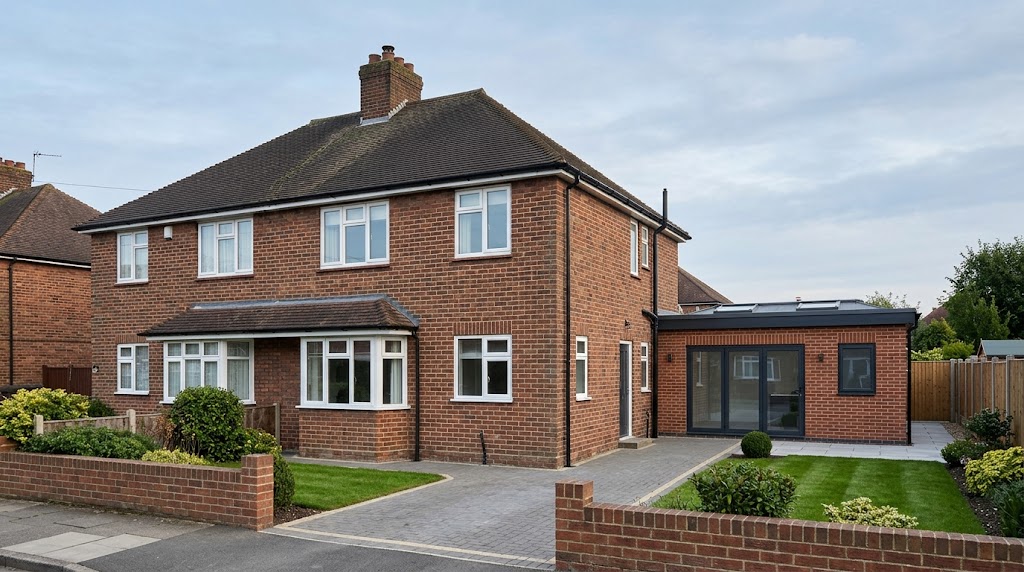
Permitted Development (PD) rights allow homeowners in England to extend and improve their homes without having to submit a full, formal planning application to their local council. Established under the Town and Country Planning (General Permitted Development) (England) Order 2015 (Schedule 2, Part 1, Class A), these statutory rules set clear parameters for allowable dimensions, heights, and boundary separations. At Peribuilders Construction, our dedicated house extensions service works with homeowners across Morden, Wimbledon, Sutton, and Mitcham to design additions that fully comply with PD rights, saving valuable time and planning application costs.
Core Rules for Single-Storey Rear Extensions Under Permitted Development
To proceed without a full planning application, a single-storey rear extension on a single-family dwellinghouse must comply with the following statutory limits:
1. Depth Limits (Standard vs Prior Approval)
Under standard Class A rules, a single-storey rear extension can extend up to 3 metres from the original rear wall of an attached house (semi-detached or terrace), and up to 4 metres for a detached house. Under the Larger Home Extension scheme, these limits double to 6 metres for attached houses and 8 metres for detached houses, subject to the Neighbour Consultation Scheme (Prior Approval) where adjoining neighbours are formally notified by the council.
2. Height Thresholds
- The overall height of the extension cannot exceed 4 metres.
- If any part of the extension sits within 2 metres of a boundary, the eaves height cannot exceed 3 metres.
- The eaves and ridge heights cannot be higher than the eaves and ridge of the original house.
3. Materials and Exterior Appearance
Materials used in exterior work must be of similar appearance to those used in the construction of the exterior of the existing dwellinghouse. Matching brick tone, mortar pointing, and roof tile profiles ensure the extension integrates harmoniously with the streetscape.
When Are Permitted Development Rights Restricted or Removed?
Permitted Development is not available on every residential property. Critical exclusions include:
- Flats and Maisonettes: PD rights apply exclusively to un-divided houses. Blocks of flats and converted maisonettes require full planning permission.
- Conservation Areas: In designated Conservation Areas (such as parts of Wimbledon Village, Merton Park, and Mitcham Cricket Green), rear extensions are subject to tighter restrictions, and side extensions are generally excluded from PD.
- Article 4 Directions: Some local authorities enact Article 4 directions withdrawing specific PD classes in defined heritage zones.
- Listed Buildings: Any alteration to a listed property requires formal Listed Building Consent.
Why You Should Always Obtain a Lawful Development Certificate (LDC)
Even when an extension falls squarely within Permitted Development parameters, applying for a Lawful Development Certificate from your local planning authority (London Borough of Merton or London Borough of Sutton) is strongly advisable. An LDC provides formal legal proof that the construction was lawful at the date of construction, preventing complications when you refinance, remortgage, or sell your home in the future.
Building Regulations are Always Mandatory
It is vital not to confuse planning permission with Building Regulations. Even if your extension does not require planning permission, it must comply fully with UK Building Regulations covering structural integrity, foundations, thermal performance (Part L), drainage (Part H), and fire safety (Part B). If your project involves knocking down walls, review our technical guide on removing a load-bearing wall and RSJ installation, or compare extension footprints in our guide to rear vs side-return vs wrap-around extensions.
Contact Peribuilders Construction to arrange an initial feasibility survey at your property to confirm whether your planned extension qualifies for Permitted Development.
Frequently Asked Questions
Planning a Project in South West London?
Peribuilders Construction delivers professional house extensions across Morden, Wimbledon, Sutton, and Mitcham. Arrange an initial site consultation today.
Related Building Guides
Rear vs Side-Return vs Wrap-Around Extensions: Which Layout Is Right?
A side-by-side comparison of rear, side-return, and wrap-around house extensions...
Read GuideOpen-Plan Kitchen Extension Ideas for London Homes
Discover practical structural layouts, roof glazing ideas, and kitchen zoning st...
Read Guide